


PEPTIDE THERAPY
explores how naturally occurring signaling peptides may support resilience, recovery, and healthy aging in your pet.

PEPTIDE THERAPY
introduction
Welcome to Earth Medicine's Peptide Therapy & Education. This section is designed to help you understand how peptides work, what current research suggests, and whether a peptide therapy may be a good fit for your pet's wellness journey.
As with all of my offerings, this is an educational consultation — I will help you explore your options so that you can make a fully informed decision for your companion. I provide guidance so that you feel empowered in your pet's care.
Please review the sections below before booking a consultation with me:

DISCLAIMER:
Educational Notice: The information provided on this page is for educational purposes only and does not constitute veterinary medical advice, diagnosis, or treatment. Dr. Sarah Meintel provides holistic wellness consultations to help pet owners explore integrative care options. If peptide therapy is recommended following a consultation, peptides are sourced and provided directly through Earth Medicine to ensure quality and purity — Dr. Meintel does not prescribe or guide dosing for peptides obtained elsewhere.

PEPTIDE EDUCATION 101
Peptides are short chains of amino acids that naturally occur in the body and act as cellular signals. Research suggests that certain peptides may support resilience, recovery, and healthy aging when used in appropriate contexts. Because they align with the body's own biology, they can sometimes provide meaningful support with comparatively small amounts.
WHAT ARE PEPTIDES?
Peptides are small proteins the body naturally produces to communicate between cells. As pets age — or with stress, illness, or environmental exposures — those signals can decline. Certain peptides have been studied for their potential to support the body's own regulatory and repair processes. In a consultation, we will explore together whether peptides may be a supportive option for your pet.
HOW ARE PEPTIDES GIVEN?
If after our consultation you choose to explore peptide therapy to support your pet, peptides are typically administered as small subcutaneous injections just under the skin. Some of these compounds are given orally. Should you move forward, I will provide you with thorough instructional guidance so you feel confident and prepared.
AREAS OF RESEARCH INTEREST (EXAMPLES):
-
Soft-tissue wellness support: muscle, tendon, and ligament recovery in active and sporting animals.
-
Gastrointestinal health: mucosal support for pets with chronic digestive concerns or inflammatory bowel issues.
-
Allergy and immune resilience: exploring the gut-immune connection and supportive approaches.
-
Post-surgical wellness: supportive care during soft tissue and orthopedic recovery periods.
-
Senior pet wellness: mobility, vitality, immune resilience, and quality of life for aging companions.
-
Geriatric and oncology support: integrative wellness consultations for pets navigating complex health journeys.
-
Preventive cycling: exploring whether periodic supportive consultations may benefit certain individuals.

FAQ's:
ARE PEPTIDES "NATURAL"?
Peptides are short chains of amino acids — essentially small pieces of proteins — that the body naturally produces and uses as cellular signals to regulate processes like repair, inflammation response, and immune function. In a supportive wellness context, carefully selected peptides may be used in very small amounts to work with the body's own biology. Our consultation focuses on helping you understand this landscape so you can make an informed decision for your pet.
HOW QUICKLY WILL WE SEE CHANGES?
Some report shifts in 4-6 weeks for injuries and mobility issues. We set longer horizons, such as 3 months, for other healing.
WHAT ABOUT SIDE EFFECTS?
Peptides are usually well tolerated at micro-doses, but any bioactive compound can cause reactions. Monitoring closely and stopping if needed is important. (Large, well-controlled safety data in pets are still limited.) sciencedirect.com.
Although less common, minor side effects are redness or swelling at the injection site. If this continues, it is recommended to stop. Although rare, more moderate side effects are vomiting, diarrhea, trouble breathing, facial swelling, severe lethargy, or collapse—in these cases stop the peptide immediately and seek veterinary support.
ARE PEPTIDES LABELED FOR ANIMAL USE?
Some peptides are investigational/off-label and not FDA-approved for veterinary use.
HOW DO I STORE MY PET'S PEPTIDES?
Peptides are to be stored in the refrigerator away from light. They are to be refrigerated at all times. If traveling you can put them in a cooler with an ice pack.
DO I REALLY NEED TO CLEAN THE TOP OF THE VIAL WITH ALCOHOL BEFORE EACH USE?
Yes, this assures there is no bacterial contamination. You can use a cotton ball with alcohol if you don’t have alcohol pads.
HOW DO I DISPOSE OF SYRINGES?
Dispose syringes in an FDA cleared sharps container. If you don’t have an FDA-cleared sharps container, you can use a heavy-duty household plastic container (e.g., an empty laundry-detergent bottle) temporarily and then take it to an approved drop-off. The container must be rigid, leak-resistant, puncture-resistant, with a tight screw cap, and clearly labeled (e.g., “SHARPS – DO NOT RECYCLE”).
You can also find nearby drop-offs via SafeNeedleDisposal’s Oregon page (lists Rogue Disposal and other programs). Safe Needle Disposal. Don’t put loose needles in the trash or recycling; don’t flush them.
HOW TO MAKE A SAFE DIY CONTAINER?
-
Choose a thick plastic bottle with a screw-on cap (laundry-detergent/bleach). Don’t use thin plastic (e.g., water/soda bottles) or anything that can be punctured easily.
-
Label clearly: “SHARPS – DO NOT RECYCLE.” (Write on the bottle.)
-
Use immediately after each injection: drop needle/syringe in point-first; do not recap, bend, or break needles. CDC
-
Fill only to ¾ full, then close and tape the cap securely.
-
Store out of reach of children and pets.

INSTRUCTIONAL VIDEOS & IMAGES
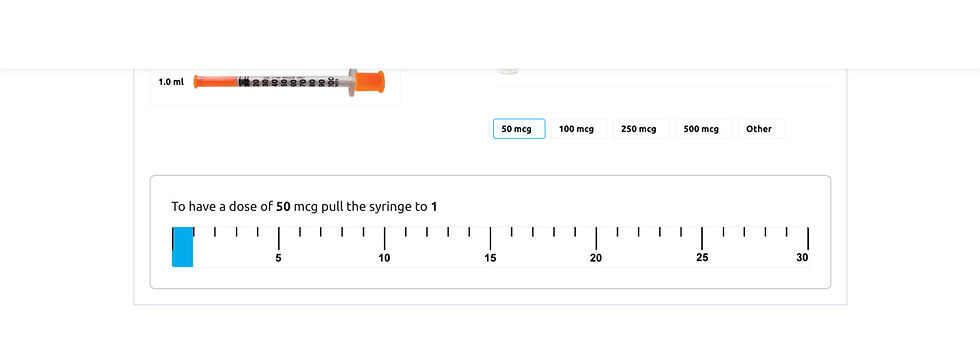
For helpful support in administering peptides to your pet companion, below are a series of instructional videos and images. Please return to this information as you need.



PEPTIDE THERAPY CONSULTATION
A focused Tele-healing or in-person visit to explore whether therapeutic peptides is a good fit for your pet. These are investigational peptides studied in preclinical models for tissue repair and resilience. Peptide Therapy is not intended to be used as a stand alone treatment or in place of medication and supportive modalities, but in conjunction with them and healthy lifestyle changes.
POTENTIAL USES OF PEPTIDES:
GASTROINTESTINAL HEALING
May support gastric/intestinal mucosal integrity and comfort; often considered when GI lining support is a goal. This would benefit pets with Inflammatory bowel disease, environmental allergies, food allergies, chronic diarrhea, chronic vomiting, and other signs of GI upset or poor function.
SOFT-TISSUE INJURIES (LIGAMENTS, TENDONS, MUSCLE)
Adjunct treatment for strains, sprains, stifle injuries, elbow injuries and overuse injuries to support tissue repair alongside rest and rehabilitation. This would benefit pets with soft tissue injuries such as shoulder OCD and partial or complete rupture of the ACL in the knee, and a multitude of other musculoskeletal issues.
POST-SURGICAL RECOVERY (SOFT TISSUE OR ORTHOPEDIC)
Potential adjunct to conventional post-operative care to support tissue healing and comfort.
ACUTE SPINAL CORD INJURY (E.G., IVDD OR FCE)
Use alongside rest and conventional care; goals are comfort and neurologic support. This would benefit the pet with pain and/or paralysis.
GERIATRIC SUPPORT (OVERALL HEALTH & WELLBEING)
May be considered to support resilience, mobility, and recovery capacity in aging pets with osteoarthritis.
CANCER PATIENT SUPPORT (OVERALL HEALTH & WELLBEING)
Adjunct focus on comfort, immune support, resilience while undergoing chemotherapy or in conjunction with a more holistic approach to supporting pets with cancer.
HOW THE CONSULTATION WORKS:
1. Medical record review before we meet.
2. During your appointment, we discuss how Peptide Therapy may apply to your pet’s specific needs and answer questions.
3. If we agree Peptide Therapy therapy may be appropriate, I will recommend a specific protocol for your pet and their needs.
4. If we move forward, your peptides will be sourced directly through Earth Medicine — this is a firm policy, as I can't verify the quality or purity of peptides from outside sources.
REFERENCES &
FURTHER READING
-
Clinical anecdotes/vet case literature: limited veterinary case reports exist (e.g., adjunct use for stifle injury), but no standardized veterinary dosing guidelines are established. ahvma.org
-
Preclinical safety/toxicology including dogs. PubMed+1
-
Dog pharmacokinetics. Beagle studies (single IV; single and repeated IM dosing) characterized PK/ADME in dogs (e.g., single IV 6 µg/kg; repeated IM 30 µg/kg ×7 days). pmc.ncbi.nlm.nih.gov
-
Equine administration & detection. LC-MS/MS studies developed assays and confirmed detectability of metabolites in horse plasma/urine after administration—useful as hard evidence of veterinary use, albeit in a doping-control context rather than therapy. PubMed+2ScienceDirect+2
-
Tβ4 animal-model review. Summarizes wound/tissue-repair effects across animal models, but not veterinary clinical trials. PubMed
-
FDA. “Certain Bulk Drug Substances for Use in Compounding.” (Updated 2025). U.S. Food and Drug Administration
-
USADA/OPSS: Prohibited unapproved drug.” (2025). opss.org+
-
Hsieh MJ, et al. Sci Rep 2020: NO-mediated vasodilation. Nature
-
Xu C, et al. Toxicol Appl Pharmacol 2020: Preclinical safety across species. sciencedirect.com
-
Vasireddi N, et al. Sports Health 2025: Orthopedic review. SAGE Journals
-
McGuire FP, et al. 2025 review: Angiogenesis/VEGFR2/Akt-eNOS pathways. PMC
-
He L, et al. 2022 PK: proposed microgram-scale dose exploration, including dog PK. PMC
-
Research & Markets (2020): ~807 in trials; ~197 marketed (market analysis). Business Wire
-
Soft-tissue & wound repair: Animal models and reviews report faster closure and improved quality of dermal and musculoskeletal healing; small human trials with topical Tβ4 suggested accelerated wound healing. PMC+1
-
Other tissues: Preclinical signals in muscle, tendon/ligament, bone, nerve, and GI mucosa; translation to standardized clinical dosing is unresolved. PMC
-
Early clinical safety work: Phase 1/2 investigations with Tβ4 examined IV/topical use and general tolerability, but did not establish approved indications. ClinicalTrials+1
-
Classified as prohibited by anti-doping authorities (USADA/WADA) and noted by other regulators (e.g., TGA) as an unapproved growth-factor peptide. Use is off- label/investigational. NPC Hello+2Wada-Ama+2
-
Angiogenesis & endothelial support via VEGFR2/Akt/eNOS pathways; modulation of nitric oxide signaling. PMC+1
-
Anti-inflammatory and cytoprotective actions across multiple injury models. SAGE Journals
-
Narrative and scoping reviews summarize improved healing in tendon/ligament, muscle, bone, and GI mucosa models, with encouraging signals but limited controlled human data to date. SAGE Journals+1
-
Safety (preclinical): multi-species toxicology work (mice, rats, rabbits, dogs) reported good tolerability at tested doses; human clinical safety remains insufficiently characterized. sciencedirect.com
-
Pharmacokinetics: early studies (including dog PK) explore exposure at microgram-scale dosing; translation to clinical veterinary dosing remains investigational. PMC
This information is educational and not a substitute for individualized veterinary advice.


BOOK A HEALING
I offer both in-person acupuncture healings and TeleHealing consultations. Please click your preference below: